
Choosing an e-bike as a heavier rider: weight limits, fit and practical checks
Substantively revised October 9, 2026 · Buying checklist; no hands-on bike testing claimed.
An e-bike's advertised capacity is useful only when you know what it includes. Start with the exact model, frame variant and market's manual. Ask the manufacturer or dealer to clarify whether its number is a rider limit, a payload limit, or a total system limit. Those numbers cannot be compared as though they mean the same thing.
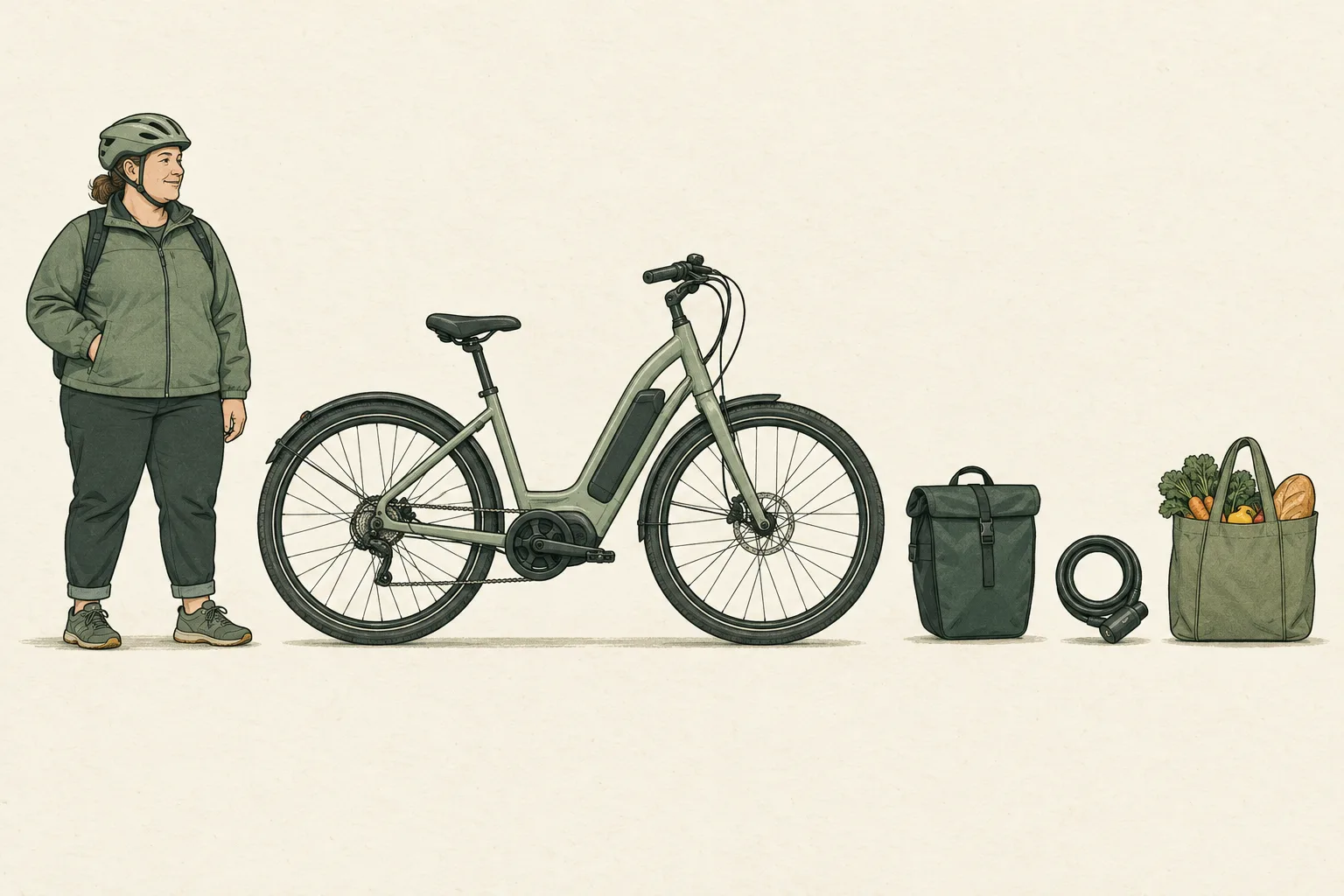
Three limits to write down
- Rider limit: the permitted weight of the person riding, under the manufacturer's definition.
- Payload limit: the permitted carried load, under that manufacturer's definition. Check whether accessories or passengers count.
- Total system or maximum gross vehicle weight: includes the bicycle itself as well as the loads specified by its manufacturer.
A high cargo rating does not establish that the bike is suitable for a rider of the same weight. Check any separate rider restriction and rack or accessory limits too. Passing one calculation does not override another limit.
Tern's GSD Gen 2 cargo guide is a useful example of a clearly defined total. Its calculation includes the bike with batteries, installed accessories, people and cargo. It also distinguishes how unbraked and independently braked trailers enter its calculation. Apply the instructions for your own bike rather than treating this manufacturer's trailer rule as universal. Tern cargo guide, updated September 1, 2026.
A worked example, not a bike recommendation
Suppose a hypothetical manual defines a 180 kg total limit, and your complete bicycle weighs 30 kg. A 120 kg rider plus 5 kg of installed equipment leaves 25 kg before reaching that total limit. That is an arithmetic allowance, not permission to load a particular rack with 25 kg: its own restriction or the separate rider limit could be lower. Include riding equipment consistently and avoid counting an accessory twice if it is already included in the weighed bike.
Questions before buying
- Can the dealer identify the applicable manual and confirm every weight restriction for this exact configuration?
- Can you mount, stop, restart and handle the bicycle comfortably on a test ride?
- Who will service the bike locally, and can they set tires and suspension within the component makers' limits for your load?
- Can you lift or move it where it will be stored? Consider stairs, transport racks and their separate limits.
- What route, hills, luggage and charging opportunities must it support? Use the battery planning tool with your own energy-use assumption; an advertised maximum range is not a promise for your trip.
Do not choose a bike from a wattage number alone. Ask how the complete bicycle performs on your intended hills and loads. Check the exact model’s specifications and instructions rather than assuming a wattage rating establishes suitability.
Useful next steps
Compare sensor behavior with ebike torque sensor vs cadence sensor, estimate capacity with ebike battery pack calculator, and include maintenance and replacement assumptions in ebike ownership cost calculator. Check route access with find your local ebike policy on federal land where relevant; location-specific rules still need current verification.
Check the rack and system limits together
Trek’s Allant+ FS FAQ separately specifies the rack limit and a system limit that includes bicycle, rider and cargo. Remaining system allowance does not increase the rack’s rating. This manufacturer example illustrates why you must satisfy both restrictions; it is not a recommendation or a verified catalogue entry. Trek Allant+ FS FAQ, checked October 9, 2026.
Setup and fit
Ask the dealer to check the exact tire, wheel, seatpost and suspension instructions against your load. Trek’s FAQ notes that suspension setup varies with rider weight and recommends following service intervals. A comfortable test ride and a confirmed load rating answer different questions; check both before buying.