
How far can an e-bike go on one charge? Range by Wh
Compare e-bike range by watt-hours, interpret manufacturer claims and calculate a reserve using measured Wh/km, with clear examples and source dates.
UpdatedUpdated
Compare a transparent ride scenario with your own measured energy use. Every default below is an illustrative assumption, not a tested bike or a recommended riding setting.
Estimate e-bike range by dividing usable battery energy above your reserve by consumption per kilometre. Use measured consumption from comparable rides when possible. Otherwise explore explicit assumptions for weight, climbing, wind, tyres and rider effort. Results are scenarios, not tested bike ranges; colder battery performance and changing routes need separate judgment.
Range is a planning estimate. This simplified model does not establish that a motor can climb your route, that riding conditions are safe, or that a battery is compatible or healthy.
59.1–88.6 km if consumption is 20% higher/lower. Sensitivity arithmetic, not a probability interval.
400 Wh available above your reserve
5.6 Wh/km modeled
Illustrative steady-speed model. Coefficients and rider effort are editable assumptions, not tested presets for your bike.
Rolling demand 2.4 Wh/km
Air drag 3.2 Wh/km
Climbing 1.5 Wh/km
Your pedal contribution 3.0 Wh/km
Motor battery demand after efficiency 5.4 Wh/km
Lights/electronics 0.2 Wh/km
The first three terms are mechanical demand. Rider effort is subtracted before motor efficiency; lights/electronics are electrical demand. These numbers must not all be added together.
A shared link includes the numeric assumptions above, including combined rider/cargo weight. Anyone with the link can read them. Values are calculated locally; these inputs are not saved by the calculator.
Energy above reserve = label Wh × usable-capacity fraction × (starting-charge fraction − reserve fraction). Measured range = available Wh ÷ entered Wh/km. Scenario range uses rolling demand, air drag and climbing energy, subtracts the assumed rider contribution, then allows for battery-to-wheel efficiency and auxiliary power.
Rolling force is modeled as mass × 9.80665 × the coefficient you enter. Air drag uses ½ × air density × CdA × relative air speed squared. Climbing uses mass × 9.80665 × ascent; 3,600 joules equal one watt-hour. Assumed sea-level air density is 1.225 kg/m³ at 15°C, scaled inversely with absolute temperature at constant pressure. Altitude, humidity and crosswinds are omitted.
This steady-speed calculation omits repeated acceleration, stop/start duty cycles, motor torque/power limits, traction, component temperature limits, battery voltage sag, battery-management cutoffs and changing gradients. Tailwinds are allowed to reduce drag to zero, but never supply modeled propulsive energy. High pedal contribution can reduce motor demand to zero; that produces no finite battery-range estimate if auxiliaries are also zero.
Use measured consumption on comparable rides when available, plan a reserve and revise assumptions as conditions change. This tool cannot validate range for an untested configuration.
Physics references checked October 11, 2026: NASA: drag equation, NASA: ideal-gas air density, and OpenStax: work and power. They support the equations, not the illustrative coefficients, default range or bike-specific accuracy. No external range-assistant output was copied; Bosch’s support page was unavailable during this check.
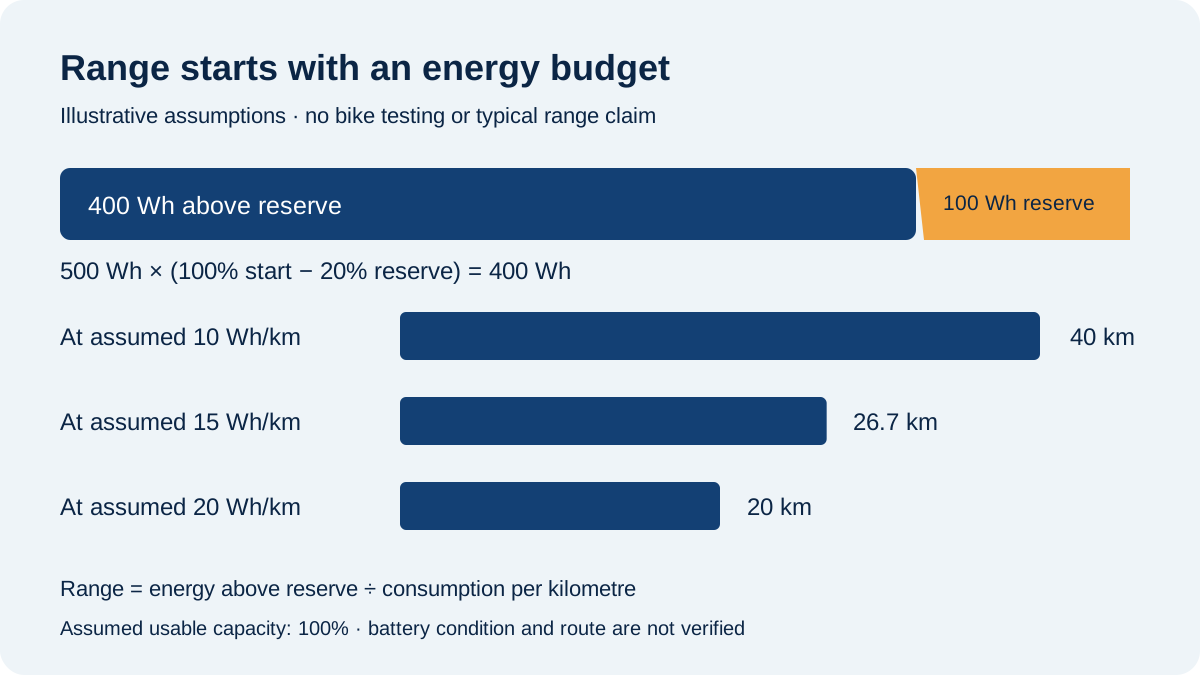
These are illustrative arithmetic examples with 100% assumed usable capacity, a full starting charge and a 20% reserve. They are not averages for road, cargo or mountain bikes. The denominator matters as much as the battery label.
| Label capacity | Energy above reserve | At 10 Wh/km | At 15 Wh/km | At 20 Wh/km |
|---|---|---|---|---|
| 400 Wh | 320 Wh | 32 km | 21.3 km | 16 km |
| 500 Wh | 400 Wh | 40 km | 26.7 km | 20 km |
| 750 Wh | 600 Wh | 60 km | 40 km | 30 km |
Start by choosing a scenario, then edit its numeric assumptions. Assistance changes our assumed rider contribution, not a manufacturer's motor setting. The rider-power input is mechanical power at the wheel for this simplified calculation; it is not a fitness measurement or a prescribed effort. Tyre presets change an illustrative rolling-resistance coefficient; they cannot identify your tyre's actual rolling loss.
If you change one assumption, keep the others fixed to see its isolated effect. Then combine changes you expect on your actual ride. A headwind, climbing and heavy load can occur together. Their real effects vary along a route, while this model uses steady speed and route-average climbing. It cannot check sustained torque, traction or a steep section's motor limits.
No. Measured mode extrapolates your entered consumption; scenario mode uses unvalidated editable coefficients. Neither certifies a battery, route or bike. The sensitivity band is arithmetic, not a confidence interval.
No. Temperature changes assumed air density in scenario mode. Enter your own usable-capacity assumption separately; the default 100% does not establish cold-weather battery performance. Follow the actual battery's operating limits.
Wall energy includes charger and battery losses and may not correspond to energy delivered during the ride. Use a reliable battery-side energy observation when available, and preserve measurement scope when dividing by distance.
If entered rider power covers modeled mechanical demand and auxiliary power is zero, the model has no battery consumption to divide by. That is a limit of the assumptions, not proof of unlimited real riding range.
Use your planned distance, entered consumption and reserve to estimate nominal watt-hours.
Open the battery-capacity calculator →Compare e-bike range by watt-hours, interpret manufacturer claims and calculate a reserve using measured Wh/km, with clear examples and source dates.
UpdatedPlan your first e-bike commute with a route rehearsal, round-trip battery example, destination checklist and ownership-cost tools.
UpdatedSeparate riding, charging and storage instructions, compare scoped manufacturer examples and make a battery storage checklist.
UpdatedAllow Google Analytics to measure visits to this site? Advertising features are disabled. You can change your choice below at any time.