

Why isn’t battery size a distance rating?
Watt-hours describe energy; kilometres describe distance. A 500 Wh label cannot, by itself, tell you whether a particular trip is within reach. The missing link is consumption: how many battery watt-hours the bike uses per kilometre under the conditions you will encounter.
Riese & Müller’s range guidance, published February 4, 2025 and checked October 11, 2026, identifies assistance, speed, terrain, temperature, wind, rider weight, cargo and tyre pressure as relevant factors. It offers a manufacturer range assistant for an initial assessment, rather than one distance that applies to every ride. These variables are reasons to examine the assumptions behind an estimate.
Keep nominal label capacity separate from usable energy. Battery condition, the starting charge and the portion you intend to leave unused all matter to your budget. A display percentage is not a laboratory measurement of stored watt-hours. Treat a percentage-based calculation as a planning approximation, especially when you do not have a reliable capacity observation.
What range does a 400, 500 or 750 Wh battery imply?
The table below holds consumption fixed so you can see the arithmetic effect of battery size. Every row assumes a full starting charge, 100% usable label capacity and a 20% reserve. The consumption columns are hypothetical inputs, not typical riding categories or results from our testing.
| Battery label | Energy above reserve | At 10 Wh/km | At 15 Wh/km | At 20 Wh/km |
|---|---|---|---|---|
| 400 Wh | 320 Wh | 32 km | 21.3 km | 16 km |
| 500 Wh | 400 Wh | 40 km | 26.7 km | 20 km |
| 750 Wh | 600 Wh | 60 km | 40 km | 30 km |
A 750 Wh pack at an entered 20 Wh/km gives less planning distance than a 500 Wh pack at an entered 10 Wh/km. That does not rank two actual bikes: their consumption, equipment, compatibility and battery condition are still unknown. Compare scenarios on equal terms before treating a larger battery as the complete answer.
How should I interpret an “up to” range claim?
As checked October 11, 2026, Lectric’s U.S. XPress2 Cruiser listing pairs a 672 Wh battery with a maximum claim of 60 miles. Priority’s Glide listing pairs 374 Wh with a 20–60 mile range band and describes throttle use versus more conservative assistance. These are maker claims, not our measured results or promises for your route.
Both listings reach the same advertised upper distance with different battery capacities. You cannot conclude that the smaller pack will reproduce the larger pack’s ride, or that one system is more efficient, without comparable testing conditions. Ask about rider and cargo mass, assistance, speed, climbing, weather, starting charge, reserve and measurement method.
Our selected XPress2 record and selected Glide record preserve configuration scope and unavailable fields. The Glide record also identifies the observed preorder notice; an advertised range is not proof that we have ridden a delivered bike.
How can I calculate range from my own ride?
If a reliable battery-side record reports 300 Wh used over 25 km, consumption is 300 ÷ 25 = 12 Wh/km. This is a hypothetical example. A wall-socket meter measures charging energy, including losses; it is not automatically the same as battery energy delivered during the ride.
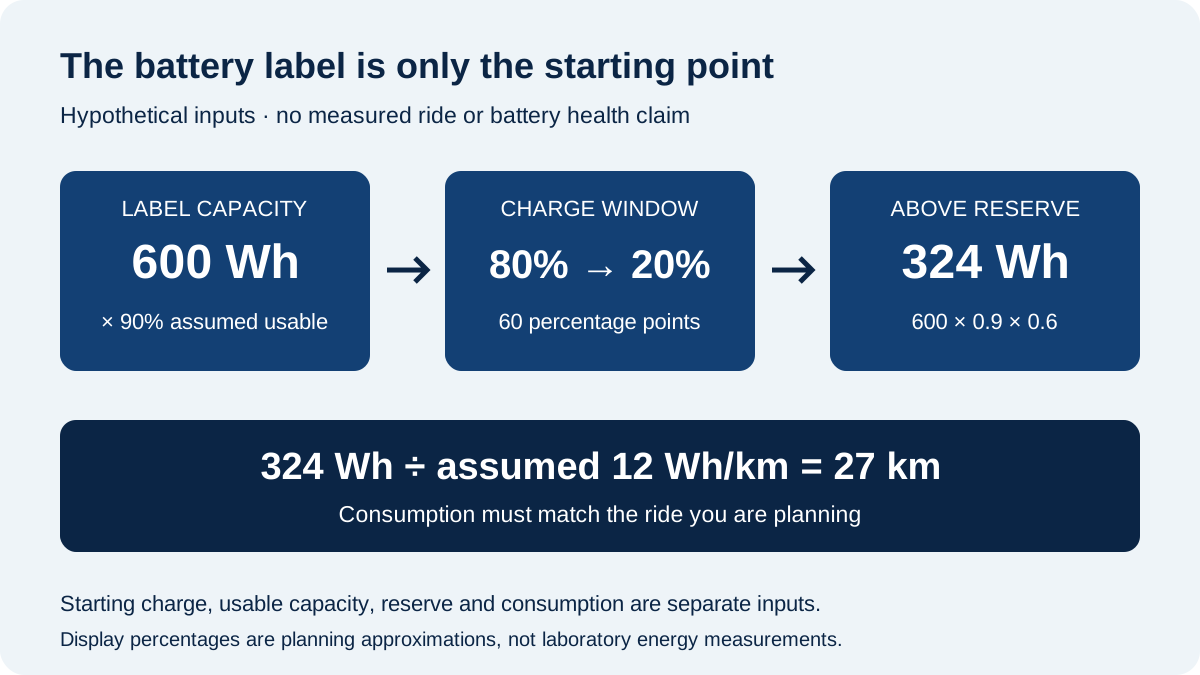
For the hero example, assume a 600 Wh label, 90% usable capacity, an 80% starting charge and a 20% reserve. Available energy is 600 × 0.9 × (0.8 − 0.2) = 324 Wh. At an entered 12 Wh/km, the planning distance is 324 ÷ 12 = 27 km. None of those inputs establishes an actual battery’s health.
Repeat observations on comparable rides instead of relying on one unusually favourable trip. Record distance, energy measurement scope, load, assistance, speed, climbing and weather. Do not deliberately exhaust a battery to obtain a number. Preserve the equipment’s operating instructions and stop using damaged or malfunctioning equipment rather than attempting a range experiment.
What changes when the route or weather changes?
The range estimator offers a separate scenario mode with visible assumptions for total mass, climbing per kilometre, speed, wind, rolling resistance, drag area, rider contribution and motor efficiency. It is a simplified steady-speed model, not a calibrated prediction for a particular e-bike. Its presets are explicitly hypothetical.
Temperature changes assumed air density in that model; it does not remove a universal percentage of battery capacity. Usable capacity is a separate input. Follow the exact battery’s operating and charging limits, and read the battery-temperature guide before treating ambient temperature as evidence that a pack is ready to use or charge.
For sensitivity, increase the example’s consumption by 20% to 14.4 Wh/km: 324 ÷ 14.4 = 22.5 km. Reducing it by 20% to 9.6 Wh/km gives 33.75 km. That interval is arithmetic, not a confidence band or assurance that your ride will fall inside it.
How much reserve should I keep for the return trip?
This guide sets no universal reserve percentage. Consider the complete round trip, detours, available assistance if conditions change, and whether the return leg has more climbing or headwind. The table’s 20% is an illustrative input, not a recommendation for every battery, route or rider.
Enter both legs when planning a commute. If the outward leg has unusually favourable conditions, do not assume the return will use the same energy. Use the commuting guide to plan practical route and storage checks, and the capacity calculator when you need to work backwards from planned distance to nominal Wh.
Which evidence and assumptions support this guide?
Checked October 11, 2026. Manufacturer claims remain attributed; the examples and figure are original hypothetical arithmetic. No road testing, average consumption dataset or battery capacity test is claimed.
- Riese & Müller: factors affecting range — published February 4, 2025.
- Lectric XPress2 Cruiser: 672 Wh and maximum 60-mile claim.
- Priority Glide: 374 Wh and 20–60 mile maker band.
- Our range model and its explicit limitations — physics sources, assumptions and measured mode.
Frequently asked questions
How far can a 500 Wh battery take me?
At an assumed 15 Wh/km, full starting charge, 100% usable capacity and 20% reserve, the arithmetic is 26.7 km. This is an illustrative scenario, not a typical or guaranteed range.
Can I compare two bikes using their maximum range claims?
Only when the configuration and testing conditions are comparable. The claims shown here are manufacturer statements, not our independent tests or efficiency rankings.
Does a larger battery always give more range?
At identical usable fractions and consumption, more Wh gives more planning distance. Different bikes and rides need not have equal consumption; compatibility and condition also matter.
How do I turn Wh per mile into Wh per kilometre?
Divide Wh per mile by 1.609344. Conversely, multiply Wh per kilometre by 1.609344 to express consumption per mile. Keep the denominator and route distance in matching units.