

The table keeps the year, quantity and source next to each figure so you can quote it accurately.
Country figures with their reporting boundaries
| Geography | Reference year | Reported figure | What is counted |
|---|---|---|---|
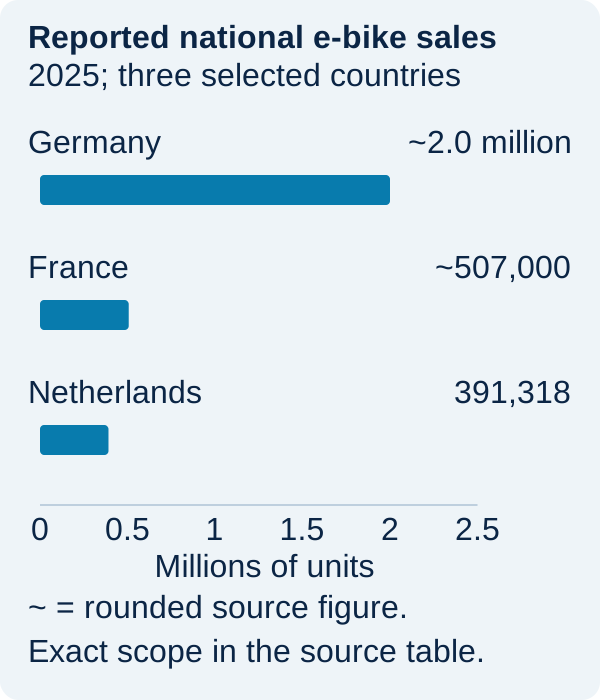
| Germany | 2025 | About 2.0 million | new e-bike unit sales. ZIV report. |
| Netherlands | 2025 | 391,318 | new e-bike unit sales. BOVAG/RAI release. |
| France | 2025 | About 507,000 | New pedal-assist (VAE) unit sales. UESC report. |
| United States | 2024 | Nearly 1 million | Reported transactions, including peer-to-peer marketplaces. PeopleForBikes. |
| Japan | 2025 | 585,074 | Domestic production of electric power-assist bicycles. JBPI table. |
Germany’s chart uses millions rounded to one decimal; France’s uses thousands. Writing their display values as 2,000,000 or 507,000 does not create unit-level precision. The Dutch release provides a unit count. Retain those differences when quoting the table.
Open the sales chart at full size.
United States: keep channels and transaction scope separate
PeopleForBikes’ June 2026 article says its research counted roughly 450,000 direct-to-consumer e-bikes sold in 2024 outside the conventional channels it discusses. It then describes nearly 1 million bikes bought or sold when about 80,000 peer-to-peer transactions are included. Keep the near-million as an approximate combined-channel statement; it does not establish an exact new-bike-only total. Do not add the 450,000 subset to it again.
The public article describes research developed with Circana and proprietary direct-to-consumer work. Its full underlying data is not reproduced here. We retain its approximation and channel boundary instead of calculating a precise US new-bike total by subtraction.
Japan: production is not retail sales
JBPI’s table dated October 28, 2026 reports 585,074 electric power-assist bicycles in the 2025 domestic-production row. Production counts vehicles made, not purchases by end customers. The neighbouring import reference row uses a broader powered-vehicle category; adding it would not establish a comparable e-bike retail count.
For the same reason, a country’s production cannot simply be added to retail sales in an importing market. The same bike may appear at more than one stage of the supply chain. A combined total needs consistent definitions and trade/inventory treatment.
Source revisions and an excluded growth claim
The French report marks its 2024 figures as revised. Its chart shows 594,000 for 2024 and 507,000 for 2025, while the adjacent annotation says a 16% decline. Those plotted endpoints calculate to about 14.6%. We retain the attributed 2025 chart value, but exclude the inconsistent growth annotation from our comparisons.
Keep the report version and units when quoting a revised series. Use a source’s supported growth figure rather than manufacturing extra precision from rounded chart values.
Download and reuse the source table
Download the source table as CSV. It includes each reference year, quantity definition, value, precision note and primary source link. Approximate values remain flagged; the file contains no worldwide total.
- Name the geography and year. Do not describe a 2024 observation as a 2025 or 2026 result because its report was published later.
- Name the quantity. New sales, used transactions, imports, production and fleet stock are different measures.
- Keep the source precision. A figure rounded to millions or thousands stays rounded.
- Check overlap before adding. A national count may already sit inside a regional total; a channel may already sit inside a combined estimate.
- Separate missing from zero. No compatible observation in this table does not mean a market had no sales.
For purchase planning rather than market reporting, start with e-bike buying costs and the model catalogue. The selling-channel guide covers the separate decision about a used bike.
Primary source pages and PDFs checked November 4, 2026.
Frequently asked questions
How many e-bikes are sold worldwide?
This table does not establish a worldwide total. Adding regional sales to production or mixing new and used transactions would combine different quantities and can double count bikes.
Does the US figure mean nearly one million new bikes?
It does not establish a new-bike-only total. The public statement includes peer-to-peer marketplace transactions and supplies an approximate combined figure, which we retain without subtracting an assumed used-bike count.
Why do some figures refer to 2024 rather than 2025?
The table uses each source’s actual reference year. A publication date in 2026 does not change the year the reported activity occurred.