

What does each battery unit mean?
| Label | Quantity | Useful question | What it does not establish |
|---|---|---|---|
| V — volt | Electrical potential difference | What voltage specification does the manufacturer give? | Energy capacity or replacement compatibility by itself |
| A — ampere | Electric current | Is this charger current, controller current or another rating? | Amp-hour capacity or a charging-time guarantee |
| Ah — amp-hour | Electric charge capacity | At which voltage and stated conditions is this rating given? | Energy comparisons between different voltages on its own |
| W — watt | Power, or energy transferred per time | Is this electrical input, rated motor power or peak output? | Stored energy, efficiency or a legal classification by itself |
| Wh — watt-hour | Energy | What nominal energy is listed for this battery? | Measured usable capacity, battery health or guaranteed range |
NIST distinguishes power in watts from energy in joules and electrical current in amperes. One watt-hour equals 3,600 joules; 1,000 Wh equals 1 kWh. Those unit relationships do not turn a marketing label into a measurement of the individual battery you own.
How do I convert volts and amp-hours into watt-hours?
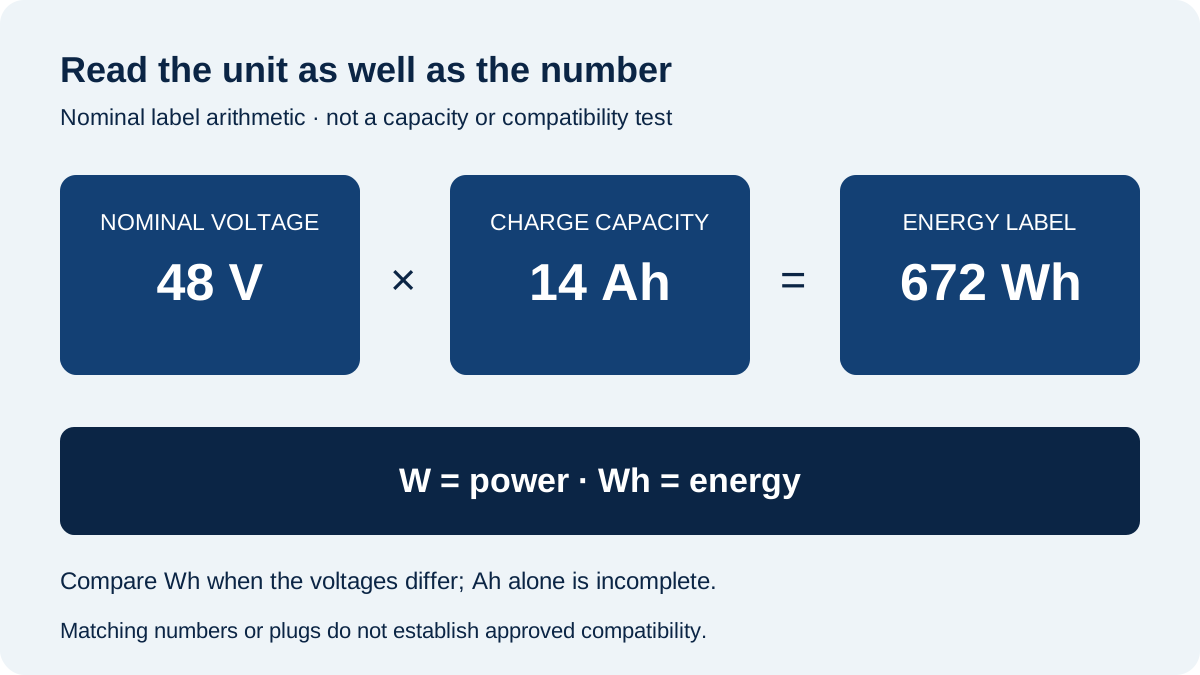
For a nominal planning calculation, multiply volts by amp-hours: Wh ≈ V × Ah. A hypothetical 36 V, 20 Ah pack gives 720 Wh; a hypothetical 48 V, 20 Ah pack gives 960 Wh. The Ah values are identical, but the nominal energy calculations differ because the voltage differs.
To work backwards, divide Wh by nominal volts: Ah ≈ Wh ÷ V. An illustrative 600 Wh at 48 V gives 12.5 Ah; at 36 V it gives about 16.7 Ah. These are alternative arithmetic descriptions, not instructions to change a bike’s voltage or install either pack.
Voltage varies during discharge, and manufacturer ratings can use stated conventions and test conditions. Nominal V × rated Ah is therefore useful label arithmetic, not an exact laboratory energy measurement. If published values do not multiply exactly, preserve what the maker actually states and ask about the difference rather than diagnosing a faulty battery from the arithmetic alone.
What do real manufacturer labels look like?
These examples were checked October 11, 2026. They belong to particular configurations and remain manufacturer claims. Our bike records keep their dates and source boundaries visible.
| Selected equipment | Maker voltage and Ah | Nominal multiplication | Published energy and scope |
|---|---|---|---|
| U.S. Lectric XPress2 Cruiser | 48 V; 14 Ah | 48 × 14 = 672 Wh | 672 Wh on the selected listing |
| Priority Glide | 36 V; 10.4 Ah | 36 × 10.4 = 374.4 Wh | 374 Wh label; arithmetic and published rating kept separate |
| Trek/Hyena BP-TR23A | 48 VDC nominal; 10.66 Ah | 48 × 10.66 = 511.68 Wh | Owner manual separately lists 520 Wh; the label arithmetic is not an exact test |
The BP-TR23A example shows why we do not overwrite a manufacturer’s published energy with a calculation using two other ratings. The exact-model Trek specifications and matching battery manual support the 520 Wh field, while the manual’s nominal voltage and Ah labels are also retained. We do not invent the manufacturer’s testing convention to explain the difference.
Why is charger output different from nominal battery voltage?
A charger’s output label describes the charger, not the battery’s nominal energy or the motor’s rated power. In the selected Trek record, the Service listing gives 54.9 V charger output, while the matching BP-TR23A manual explicitly gives 48 VDC nominal battery voltage. Its Service parts entry also lists 47.3 V without classifying that value.
Keep those observations attributed and separate. Do not copy the charger output into a battery nominal-voltage field, and do not assume any charger carrying one of those numbers is approved. Follow the exact manufacturer’s equipment instructions, part identifiers, mounting, connectors and battery-management requirements.
Does a 500 W motor use a 500 Wh battery in one hour?
Only an idealized constant electrical draw of 500 W for one hour corresponds to 500 Wh of energy. A motor’s advertised or rated power does not say that its battery draw remains at that value for every second of a ride. Rider effort, assistance, operating conditions and losses matter; electrical input and mechanical output are different quantities.
Our records distinguish rated or claimed power from peak power and independently measured output. A large watt figure is not a substitute for energy, range, fit or a check of the applicable riding rules.
How do battery units connect to range and charging cost?
For range planning, divide energy available above your reserve by consumption per distance. For example, an assumed 400 Wh available at an entered 15 Wh/km gives about 26.7 km. Read how far an e-bike can go on one charge for reserve and measurement scope, or use the range estimator.
For charging cost, convert Wh to kWh and distinguish energy added to the battery from electricity drawn at the wall. An illustrative 500 Wh is 0.5 kWh before allowing for charging losses. The charging-cost tool exposes your entered efficiency and electricity rate; it does not give a current utility quote.
Dated references and label scope
Checked October 11, 2026. Unit definitions and conversions are distinguished from manufacturer ratings and original hypothetical examples. No battery capacity, charger compatibility, health, certification lookup or road test is claimed.
Frequently asked questions
What is the difference between Ah and Wh?
Ah describes charge capacity; Wh describes energy. Nominal voltage multiplied by Ah gives approximate Wh for planning, so Ah alone cannot compare packs at different voltages.
How many Wh are in a 48 V, 14 Ah battery?
Nominal label arithmetic gives 48 × 14 = 672 Wh. That does not measure an individual battery’s usable capacity, condition or compatibility.
Is a higher-voltage battery automatically a better replacement?
No. Follow the bike manufacturer’s approved electrical and mechanical requirements. A different voltage or a matching connector is not a compatibility decision.
Does the charger voltage replace the battery’s nominal voltage?
No. Keep the charger output specification and the battery nominal label separate. Use the exact approved equipment instructions rather than substituting one label into another field.